PaperTrade (PAPER) Token Explained: Tokenomics, Total Supply, Exchange Listings & Future Outlook | CryptoEdy
PRODeep Dives Research
PaperTrade (PAPER) Token Explained: Tokenomics, Total Supply, Exchange Listings & Future Outlook
CE
Lead Analyst
Oct 13, 202631 min read
PaperTrade (PAPER) Tokenomics Explained: Supply, Utility and How It Works, Can PaperTrade Grow in the Future? Will PAPER Token Be Listed on Binance or Other Exchanges?
PaperTrade DEX, Explained: PAPER Tokenomics, 10x ,20x,50x,100x,200x,500x 1,000x Leverage, Liquidity Risks and Hedging Strategies:
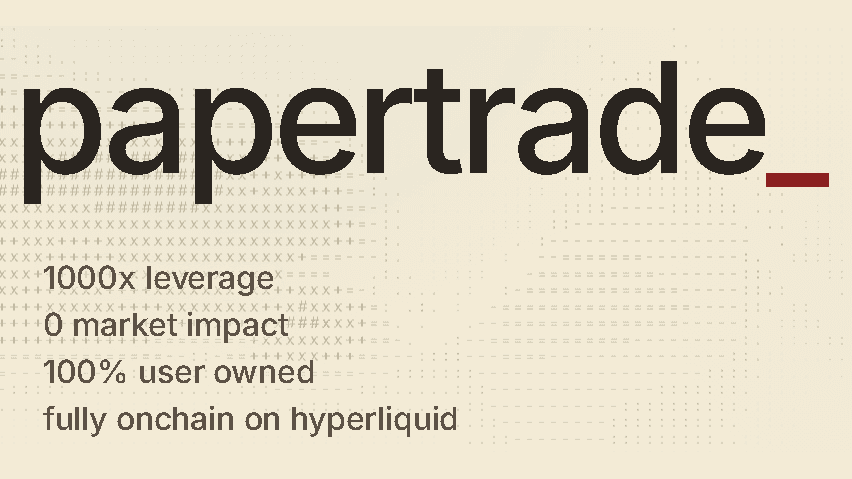
Papertrade : Papertrade.xyz is a synthetic perpetuals decentralized exchange built on HyperEVM, the smart-contract execution layer of the Hyperliquid ecosystem. Its design combines extreme leverage, oracle-based execution and a liquidity pool that acts as the counterparty to traders. Rather than relying on a conventional order book, the protocol settles synthetic positions against its own liquidity pool using a reference price derived from Hyperliquid's best bid and offer (BBO).
The platform's most unusual feature is its PAPER token, which is designed around a lose-to-earn model: traders who realize losses can receive newly minted tokens, while PAPER stakers participate in protocol revenue distributions under the stated token economics.
That design creates an unconventional relationship between trading losses, liquidity-pool solvency and token issuance. It also introduces risks that deserve close attention, particularly when positions are opened with leverage as high as 1,000x.
There are NO founder tokens, no pre-mint, no team/VC allocation, no airdrop and no vesting. PAPER supply starts at 0 and grows inflationarily: each time traders lose (add USDC to the LP), PAPER is minted to the losing traders as a “loss-backed” token.
The official token contract is deployed on Robinhood Chain (chain ID 4663) at 0xAA3b129e4906009e228a060340601260de068ff5 (PAPER), and trading will ultimately settle on Hyperliquid’s HyperEVM.
No public exchange listings , no CEX or official DEX listing have been announced till 13 October 2026. Given the ultra-high-leverage, no-fee design, trading volume could be volatile; liquidity is entirely self‑bootstrapped. This raises significant market risks: inflationary pressure and dilution from continuous emissions, uncertain demand if traders dump PAPER, and payout risk if the LP can’t cover winners (requiring FIFO queuing).In a with massive volume, the LP would grow quickly (unlocking extra staking rewards above $5 M) and PAPER could see strong demand from stakers; but supply would also spike (e.g. $1 M in losses mints 100 M PAPER), pressuring price.In a , low volume means low new issuance but also lower revenue to support price, and winners may struggle to withdraw funds if losses dry up. In short, PAPER is a whose value depends on sustained trading, LP health, and staking yields.
Papertrade’s own docs describe PAPER as a loss-issued, fee‑claim ERC20 with zero initial supply and no pre-allocations. Staked PAPER earns USDC from LP profits. Losses add USDC to the LP (called the “Martingaler LP”), and PAPER is minted to losing traders as rewards. The token’s only utility is sharing LP revenues (no governance or fixed rewards).
All tokenomics come from official docs and on-chain logic: emission rules are flat-then-ratchet (100 per $1 until $2M); staking share is continuous USDC dividends.
How Papertrade's trading model works:
The platform's principal features are:
Synthetic perpetual positions: Traders gain leveraged exposure to the price movement of supported assets without trading conventional perpetual contracts on Papertrade's own order book.
Up to 1,000x leverage: Small price movements can consume the entire initial margin of a highly leveraged position.
Oracle-based execution: Entry and exit prices are derived from Hyperliquid's BBO midpoint.
Protocol liquidity pool: The pool takes the opposite economic side of traders' positions.
Loss-linked token issuance: Eligible realized trading losses can trigger the minting of PAPER.
Queued payouts: Profitable positions may face delayed settlement if the pool cannot immediately meet its obligations.
These features make Papertrade structurally different from a conventional centralized derivatives venue. They also mean that traders must evaluate both the market risk of their positions and the financial condition of the protocol's counterparty pool.
How to Connect a Wallet and Fund Papertrade on HyperEVM
Papertrade operates within the Hyperliquid ecosystem, so a wallet must be configured for the appropriate network and funded with the assets required for deposits and transaction fees.
The following describes the setup process presented in the source material. Network parameters, supported deposit routes, minimum deposits and fees should be checked against the official project interface before any funds are transferred.
Step 1: Configure a compatible wallet
Self-custodial wallets such as MetaMask or Rabby or Phantom can support EVM-compatible networks. The source article lists the following HyperEVM network parameters: Setting Value stated in the source Network name- Hyperliquid RPC endpoint- https://rpc.hyperliquid.xyz/evm Chain ID- 999 Native gas token - HYPE explorer- HyperEVMScan
Step-2:Move assets into the correct environment:
The source describes a workflow in which users deposit USDC into their Hyperliquid account, acquire HYPE for HyperEVM transaction fees, and transfer HYPE to their EVM wallet.
In practice, the correct route depends on the currently supported bridge, deposit interface and wallet configuration. Users should confirm the network and token contract at every stage rather than assuming that USDC held on Ethereum, Arbitrum or another network is automatically available on HyperEVM.
HYPE is used for gas on HyperEVM. The native gas requirement is separate from the collateral needed to open a trading position.
Step3: Deposit into Papertrade
After connecting a compatible wallet, users can review the deposit interface and the supported collateral assets.
The original source states a minimum deposit of $10 USDC and a one-time $1 activation fee. These are source-reported figures, not independently confirmed current terms.
Before depositing, verify the minimum amount, activation fee, withdrawal conditions, contract address and whether any funds may become subject to a payout queue. A small initial deposit can help test basic wallet connectivity, but it does not establish that the protocol is safe for larger positions.
How the PAPER Token's Lose-to-Earn Model Works
PAPER is the native token associated with Papertrade's incentive and revenue-sharing design. Its defining characteristic is that eligible trader losses can create new token supply.
The source describes an initial supply of zero, with no initial team allocation, venture-capital allocation or traditional airdrop. Under this model, PAPER issuance is linked to realized losses rather than to a predetermined emissions schedule alone.
The concept is unusual because it connects the behavior of losing traders directly to the ownership structure of the protocol's future cash flows.
PAPER minting and the loss-based emission curve
The source describes the following initial minting mechanism:
When the liquidity pool is below $2 million, eligible realized losses generate 100 PAPER per $1 lost.
As the pool grows, the number of tokens minted for each dollar of eligible loss declines.
At a stated pool valuation of $5 million, the example minting rate falls to approximately 95 PAPER per $1 lost.
These figures describe the mechanism as presented in the original article. The exact live curve, its reference balance, rounding rules and treatment of liquidations should be verified against the deployed contract.
The economic principle is straightforward: when the pool is relatively small, the protocol offers a higher PAPER emission rate to incentivize participation. As the pool grows, the rate decreases, potentially reducing the number of new tokens issued for each subsequent loss.
However, a declining emission rate does not guarantee that the token will retain value. The result depends on total supply growth, staking participation, protocol revenue, the distribution rules and the market's valuation of the associated economic rights.
Why would a trader receive PAPER after losing money?
Under the described design, losing traders receive tokens instead of treating their entire loss as having no residual protocol-related benefit.
This does not reverse the trading loss. A trader who loses $1 has still surrendered $1 of trading value, even if that loss qualifies them to receive PAPER.
The economic value of those tokens depends on their actual utility, transferability, staking eligibility and share of future distributions. If the token cannot be transferred or sold, its holder may have limited flexibility to realize any economic benefit.
There is also a critical distinction between the number of tokens received and their economic value. Receiving 100 PAPER for a $1 loss does not establish that those tokens are worth $1, $100 or any other amount. That conclusion would require a defensible valuation of the rights attached to each token.
Does PAPER have a maximum supply?
The source does not establish a fixed maximum supply. Instead, it describes a token whose supply grows as qualifying trading losses occur.
Unless the deployed contracts impose a hard cap or another binding supply constraint, it is more accurate to treat PAPER as a potentially expanding-supply token than to assume a fixed maximum supply.
The long-term implications depend on the balance between new issuance and the economic benefits accruing to token holders. A larger token supply can dilute each holder's proportional claim on future distributions unless revenue or other benefits increase sufficiently.
PAPER Staking and Protocol Revenue
The source describes PAPER staking as a way for holders to participate in protocol revenue distributions. According to the stated launch economics, stakers can receive 50% of specified protocol revenue, including a reported 2% charge on winning traders' realized profits. The source also describes a mechanism through which pool profits above a $5 million buffer cap can be directed to PAPER stakers. These terms should be treated as protocol-specific claims that require verification against the live staking contract and revenue-distribution rules.
How staking rewards are intended to work
The described model has three principal stages:
Traders realize eligible losses, triggering PAPER issuance.
Token holders stake their PAPER in the protocol's staking mechanism.
Eligible protocol revenue is distributed among stakers according to the applicable rules.
A staker's actual reward depends on more than the headline revenue-sharing percentage. It also depends on the revenue eligible for distribution, the total amount of PAPER staked, the timing of distributions and any contract-level restrictions.
For example, if eligible revenue remains unchanged while the amount of staked PAPER increases, the share attributable to each token may decline.
Likewise, a period of elevated trading activity may generate substantial revenue but also coincide with aggressive token issuance, liquidity stress or unusually high liquidation activity.
A stated revenue share is not the same as a guaranteed yield. Staking rewards can vary, and their economic value depends on the protocol's actual cash flows and ability to distribute them.
What happens when the pool exceeds its buffer?
The source describes a $5 million pool buffer, above which qualifying excess profits may be allocated to stakers.
This mechanism is intended to link staking rewards to the pool's financial performance. Its effectiveness depends on the precise definition of the pool balance, how unrealized obligations are accounted for, and whether pending trader payouts take priority over distributions to stakers.
Those details matter because a pool can appear well funded while still carrying substantial contingent liabilities.
Before evaluating PAPER staking as a source of income, investors should establish:
Which fees and profits qualify for distribution.
Whether queued trader claims rank ahead of staker distributions.
How the protocol calculates its liquidity buffer.
How token issuance changes each staker's proportional share.
Whether rewards are distributed automatically or require a claim transaction.
Without those details, a headline revenue percentage provides an incomplete picture of the token's economic value.
Queued Payouts: The Liquidity Risk Behind Papertrade
One of the most consequential features in the source material is the protocol's queued-debt mechanism.
If profitable traders collectively claim more than the liquidity pool can immediately pay, the source states that outstanding winnings can enter a queue. Subsequent losses replenish the pool, allowing pending obligations to be settled over time.
This creates a direct connection between trading performance and withdrawal liquidity.
How queued debt can develop
Consider a simplified example.
A trader closes a profitable position and is owed $10,000. The pool, however, has insufficient immediately available USDC to pay the entire amount.
Instead of receiving the full profit immediately, the trader may receive a claim recorded in the protocol's payout queue. If the protocol later receives additional funds from losing trades, some of that liquidity may be used to settle outstanding claims.
The important distinction is between a recorded claim and immediately withdrawable USDC.
A queued payout is not equivalent to cash in a wallet. Its eventual settlement depends on the protocol's contract rules, available liquidity and the treatment of other outstanding obligations.
Nor should users assume that a queued claim is guaranteed to be paid in full or within a predictable period unless the deployed contracts and their economic arrangements support that conclusion.
Why can the queue become a structural problem?
A liquidity pool funded primarily by trader losses can face stress when market conditions favor winning traders.
If a strong directional move produces large net obligations, the pool may have to delay some payouts. If subsequent losses are insufficient to replenish it, the queue may remain outstanding for an extended period.
This creates a potentially adverse feedback loop:
Winning traders create payout obligations.
Available liquidity declines.
Withdrawals become delayed if the pool cannot meet those obligations.
The protocol relies on future inflows to restore payment capacity.
The model therefore has a different risk profile from a trading venue that maintains substantial independently funded reserves or has clearly defined external liquidity arrangements.
A trader may correctly predict the market direction and still encounter a liquidity problem when trying to realize the full economic benefit of the trade.
Token Function & Utility:
PAPER has no intrinsic value apart from protocol participation. Its sole role is as an LP fee-claim token. The intended use cases are:
Fee Revenue Share: Staked PAPER holders earn a pro-rata share of protocol fees (converted to USDC) from the shared liquidity pool. Specifically, stakers automatically accrue USDC from traders’ losses/profits. Once the LP exceeds $5 M, any “excess” gains beyond that threshold are also routed to PAPER stakers. This creates a yield for token holders tied to trading volume.
Incentive for Losing Traders: PAPER is given only to traders who lose money on the platform. When a trader’s position closes at a loss (or is liquidated), their loss $L is sent to the LP and triggers minting of PAPER according to the emission curve. The losing trader receives the newly-minted PAPER. This acts as a “polluting mitigation” – losing traders get PAPER as a consolation prize. However, it does not reimburse their loss (the USDC loss stays in the LP).
No Governance or Voting: There is no mention of governance rights or token-holders’ votes. The project is described as “100% user owned” in the sense that no insiders hold tokens, but PAPER itself is not a governance token. Its value comes solely from future revenue claims, not protocol control.
No Trading Fees for Traders: The platform advertises zero trading fees and zero funding rates for users. In practice, this means PAPER and the LP mechanics replace the usual fee structure: rather than traders paying fees, winners are paid directly from the LP (if available) and losers replenish the LP (minting PAPER). The only implicit “fee” is the price impact/cost applied on closing profitable trades, which sends extra USDC to the LP.
Stake-to-Play: Until PAPER becomes transferable (the initial token model suggests it may be non-transferable at launch, only stakable), losing traders cannot immediately sell it. Instead they must stake PAPER to earn USDC. Over time, the token is expected to become freely tradable, but the main value proposition remains the staking rewards.
In summary, PAPER is purely a loss-token with staking utility. It grants holders a claim on future LP profits. Its issuance is “gameable” by taking losses, but its value depends entirely on continued volume (trading fees) and demand to stake or hold the token. As one analyst noted, PAPER is essentially a “loss-backed” token distributed in place of losses, so whether it has value hinges on growth of the protocol’s revenue pool.
Issuance & Emission Curve:
Flat Rate Phase (LP ≤ $2 M): While the LP total (net of queued payouts) is under $2,000,000, PAPER mints at 100 tokens per $1 of LP growth. For example, a $10,000 trader loss would mint 1,000,000 PAPER. This includes recovery from negative LP balances (the same 100:1 rate applies until the LP goes positive).
Decay Phase (LP > $2 M): After the LP surpasses $2M, the mint rate begins to decay using a high-watermark (ratchet) curve. In practice, initial documentation suggests a “flat-then-ratchet” default: a $2M threshold and a large decay scale (e.g. $120M). Roughly, this means each additional dollar of LP gain mints slightly fewer PAPER than the previous dollar. The exact curve is encoded on-chain (tracked via a value tracked that records peak LP). Importantly, the emission never resets to 100:1 when the LP shrinks – once you move past $2M of net growth, the lower mint rates persist (unless the LP falls back below zero, in which case the flat rate temporarily returns).
High-Watermark: The design uses a high-watermark (“trackedLpUsd”) so that once the protocol has advanced deep into the tail region above $2M, later pumping of PAPER is capped by the maximum historical LP, not just the current balance. This prevents scenarios where the LP grows, gets partially swept to stakers, and then the mint rate would otherwise spike again. Only a fall below the $2M threshold or to negative triggers the flat 100:1 floor to help rebuild the LP.
Minting to Traders: All PAPER minting is on-chain, automatic, and recorded. Contracts assign newly minted tokens directly to the losing traders responsible for the LP gain. There is no off-chain or hidden logic: issuance only occurs through the smart contracts when positions close at a loss.
No inflation cap or deflation mechanism is mentioned. Thus, total supply will grow without bound as long as losses occur. Commentators warn this leads to dilution: issuing more PAPER after each loss broadens distribution but also dilutes existing holders if revenue (LP growth) doesn’t keep pace. If growth stalls, PAPER holders bear the full inflation effect.
Staking and Rewards:
PAPER’s primary utility is staking. The system works as follows:
Staking Entitlement: Staking PAPER grants a pro-rata share of all USDC revenues flowing into the LP. In simple terms, every time the LP gains USDC (from trader losses or impact fees on winners), a percentage is diverted to stakers. This is distributed continuously to stakers in USDC.
Revenue Sources: Since traders pay no fees, the only revenue to the LP comes from price impact on profitable trades and losing trades themselves. In effect, stakers earn part of every losing trader’s cash injection. The exact share mechanism is built into the smart contracts (not publicly detailed in the docs), but the marketing says stakers earn LP revenue in USDC.
5M Cap Bonus: A key parameter is the $5,000,000 threshold. Once the LP’s accumulated value exceeds $5M, extra USDC can be “swept” to stakers. Concretely, normal protocol “fees” go partly to the LP and partly to stakers; when LP > $5M, a larger slice flows to stakers. This aligns stakers with deep pool growth (they earn more when the system is healthy). No similar bonus is mentioned for when LP is below $5M.
No Governance Voting: Staking PAPER does not confer governance votes or any rights beyond revenue. It simply locks tokens to earn yield.
Lock-up/Unstaking: The documentation does not detail lock-up times or penalty, but given the “no-vesting” ethos, unstaking is presumably free and immediate. The only incentive to lock longer would be yield mechanisms (if implemented) or tiered rewards (none specified except the 5M trigger).
In summary, PAPER staking turns the token into a yield-bearing asset tied to platform revenue. The strength of the reward depends entirely on trading volume (more volume → more LP gains → more USDC revenue to share).
Listing & Market Status:
No official exchange listings are announced as on 13 October 2026. Papertrade’s public channels (docs and tweets) mention only the on-chain trading interface and fair-launch plan. The token’s initial distribution occurs on-chain; it was revealed via a Robinhood chain sale/launchpad on Oct 7, 2026.
The only planned “liquidity” per docs is the Martingaler LP which starts at $0. Users cannot add liquidity themselves. All trading liquidity must be generated by the protocol via losses. Thus, initial liquidity on launch was effectively zero until trading began.
Given Papertrade’s novel model (no order book, no external LPs), conventional listing strategies (seed liquidity, market makers) do not apply. The team has not announced any listing partnerships. It’s possible PAPER could later be bridged to Ethereum or Arbitrum with liquidity on Uniswap-like DEXes, but no roadmap is given as on 13 october 2026.
We judge “planned listing timeline” unspecified. The fair-launch theme suggests no private or ICO, but also implies minimal promotion. If any, listings might only come after some track record. For now, liquidity is extremely low and listing on venues should be considered speculative and unlikely in the short term.
Trading & Price Outlook:
Liquidity & Depth: The only deep pool is the Martingaler LP, which starts at $0 and grows with losses. Early trading (especially in the first weeks) will face shallow liquidity: wins by traders will quickly deplete the LP and trigger the FIFO payout queue, as warned by the team. On-chain data should be watched for queue lengths. Price stability is highly uncertain until the LP accumulates a meaningful reserve. Any single large win (e.g. a 1000x leveraged position) could drain the LP and shift the market price dramatically.
Inflationary Pressure: PAPER is strongly inflationary. For example, every $1 of losses mints 100 tokens (under $2M LP). In a bull run with heavy volume (say $10M of losses), that means 1,000,000,000 PAPER could be minted. Without sinks, this dilutes existing supply. If demand (staking or trading) doesn’t scale equally, token price will suffer. Past emission curves (e.g. FCoin’s trade-to-mine) showed tokens oversupplied quickly, crashing value. PAPER faces a similar risk: each trade amplifies supply. Practically, holders can only realize value if enough traders buy PAPER (out of staking or speculation) to absorb new supply.
Bull Scenario: High-volume usage drives LP > $5M (unlocking extra staking rewards) and many losses → heavy issuance. If PAPER becomes widely accepted, staking yields could buoy price. But even in this best case, token supply could be vast. For example, if the LP grew from $0 to $5M, the first $2M adds 200M tokens; the next $3M (slower rate) might add ~300M more (total ~500M). At $1.00 per token, that’s $500M market cap; but if price is lower (say $0.10), market cap is $50M. It’s unclear what valuation PAPER could sustain. (By contrast, total revenue in a given week might only be small millions, so $0.10 might already price-in high future earnings.)
Bear Scenario: Low volume means few new tokens and little LP growth. Early holders (especially loss generators) would have minted tokens at high rates, but find few buyers. Without new LP gains, stakers earn little, so staking incentive fades. Many participants could dump PAPER, collapsing the price. The LP itself may deplete (queuing winners), undermining confidence in the system’s payout ability. In a bearish market, Papertrade’s model is untested; historically, “giveaway” tokens from losses often crash once promotions end. PAPER lacks natural sinks (no buyback or burn), so prolonged bear pressure could lead to a steep decline.
Comparables: Analysts compare Papertrade’s model to FCoin’s “trade-to-mine” and its 2020 collapse. Both give tokens to traders, but Papertrade is worse: only losers get tokens, and tokens can’t be redeemed for lost funds. Like FCoin, Papertrade’s math is transparent (on-chain), but it still forms an open-ended pyramid where future trading losses are needed to pay current winners and justify current token holders.
Quantitative Example: If 1,000 traders each lose $100 (total $100k to LP), under the flat rate they’d collectively mint 10,000,000 PAPER. If no one buys that PAPER (staking or in market), its price would collapse (e.g. if each token were $0.001, the loss per trader would be only covered by 10,000 tokens worth $10; a far cry from the $100 lost). To offer any recovery, PAPER’s price would need to be fairly high. Conversely, if LP grows $100k and PAPER price is $0.01, those 10M tokens are worth $100k – matching the LP injection. But achieving that requires either strong demand or enormous staking lock-ups. Such dynamics make price highly sensitive to volume, with extreme inflationary risk if growth falters.
Overall, PAPER’s future price depends on a delicate balance: LP health (profitability of trading), emission rates (dilution), and token demand (staking vs selling). Small changes in volume or sentiment could swing price wildly.
Monitoring Points:
Launch & Mainnet: Watch for the official trading launch and the end of any deposit window. The team mentioned a pre-announced deposit phase (in Oct 2026). The actual launch time (Aug 2026 launch target shifted to Oct) and first trades will set initial LP and token flows.
Contract Audits: Guardian Audits engagement was announced for Summer 2026. The audit report (when published) should be reviewed for any hidden fees, mint logic, or restrictions. Security issues could also impact price.
LP Milestones ($2M, $5M): The emission curve hinges on $2M and $5M thresholds. Whether and when the LP surpasses $2M is critical: below it, incentives are strongest (100:1); above it, issuance slows. Similarly, $5M triggers extra staking rewards. On-chain explorers or the team’s dashboard should be checked for LP balance. These are game-changing events for tokenomics.
FIFO Queue Usage: Track if the LP ever hits zero and payments queue up. Frequent queuing (winners waiting for funds) would alarm traders and could signal imminent troubles. Low queue activity suggests a healthy LP.
Emission Parameters: The contracts likely allow parameter changes. Monitor GitHub or docs for any changes to the 100:1 rate, thresholds, or decay scale. If the team adjusts these (e.g. to curb inflation), it will impact long-term supply.
Token Transfers/Lock-Up: If PAPER is non-transferable initially (as implied), note when that lock lifts. The value is tied to ability to trade or stake. Any vesting for early stakers (PaperDAO arrangement suggests lock periods) should also be watched.
Exchange Listings: Any announcements of CEX listings (Robinhood Chain exchanges or bridges to EVM chains) will affect liquidity and price discovery. Given the unique chain (4663), check new DEXs listing Robinhood assets or any bridging to mainnets.
Market Sentiment & Volume: Monitor trading volume and prices on on-chain DEXs (like Jupiter or any emerging DEXes on HyperEVM). Sudden spikes in volume can indicate whale activity or pump, while prolonged low volume may precede a dump.
Overall, key metrics to watch are LP size, staking yields, token supply growth, and queue length. These on-chain numbers – more than price charts – will signal the protocol’s health.
The token flow and dynamics :
Overview of the Individuals Behind Papertrade: Jez and Blurr
Papertrade is being developed by Jez (@izebel_eth), publicly identified as Colin Hong, and Blurr. Hong holds a degree from MIT, worked at Morgan Stanley for four years, and serves as a venture partner at Standard Crypto. His interest in financial markets began as a teenager trading Team Fortress 2 in-game items, where he reportedly grew an initial investment of around $50 into several thousand dollars. He later expanded into options trading and cryptocurrency.
Jez applies his “good new thing hunting” strategy to crypto, identifying innovative products with strong fundamentals before the broader market recognizes their value. He placed seventh in the 2024 WPT Prime Championship, winning $186,000, and was selected by Coinbase for an in-person trading competition in Singapore on 8 October 2026. He has also researched equity perpetual pricing, focusing on how stock dividends should affect perpetual contract prices and funding payments.
BLURR: Blurr’s early crypto experience began with on-chain experimentation through CryptoKitties, an Ethereum-based NFT game involving collecting, breeding, and trading digital cats. During the 2017 crypto boom, one CryptoKitty reportedly sold for approximately $118,000, highlighting the market’s early potential. Interview with Thereadguy
Papertrade Accumulation Zone and our View: Trade both long and short positions in BTC and ETH using your expertise and trading strategy. You may choose to close some positions at a loss or allow them to be liquidated, depending on your trading objectives. Consider allocating only 1%–2% of your total crypto portfolio to leveraged trading positions.
At the current rate, you may receive approximately 50–70 PAPER tokens per $1 loss. You may accumulate till allocation of around 20–40 PAPER tokens per $1.
The platform has already recorded approximately $250 billion in trading volume, and you may become eligible to receive revenue-sharing benefits by staking PAPER tokens, subject to the platform’s terms and conditions.
Frequently Asked Questions
What is Papertrade.xyz?
Papertrade.xyz is a synthetic perpetuals trading platform built on HyperEVM in the Hyperliquid ecosystem. It uses a reference price derived from Hyperliquid's BBO midpoint and settles positions against a protocol liquidity pool.
What is the PAPER token?
PAPER is the token associated with Papertrade's loss-linked issuance and staking design. Under the described model, eligible realized trading losses generate new tokens, and stakers can participate in specified protocol revenue distributions.
Does PAPER have a fixed maximum supply?
The source material does not establish a fixed maximum supply. Because issuance is linked to qualifying trading losses, the total supply may expand unless the deployed contract imposes a binding cap or another supply constraint.
How does PAPER staking generate rewards?
The described model allocates a portion of eligible protocol revenue to PAPER stakers. Actual rewards depend on the applicable distribution rules, protocol revenue, the amount of PAPER staked and the contract's current state. A stated revenue share is not a guaranteed yield.
What is a queued payout on Papertrade?
A queued payout is a claim for winnings that cannot be settled immediately because the protocol's available liquidity is insufficient. The claim may be paid as liquidity becomes available, subject to the contract's rules and outstanding obligations.
Is 1,000x leverage safe?
No leverage level eliminates trading risk, and 1,000x leverage leaves very little room for adverse price movement. A small change in the reference price can consume the initial margin, while liquidation and execution rules can produce outcomes different from simplified calculations.
Can delta hedging eliminate risk on Papertrade?
No. Matching opposing positions can reduce directional exposure while both legs remain open, but it does not eliminate liquidation, oracle, funding, execution, counterparty or payout-delay risks.
How can users verify Papertrade contract activity?
Users should obtain contract addresses from official project documentation, verify the contracts on HyperEVMScan and inspect the relevant functions and transaction history. Function names and addresses quoted in secondary articles should not be assumed to match the current deployment.
⚠️Disclaimer: This report is for informational and research purposes only. It does not constitute financial, investment, or trading advice.Cryptocurrency investments carry significant risk. Always conduct your own research before making investment decisions. Cryptocurrency assets, including PAPERTRADE, is highly volatile, and past performance and stated roadmaps are not guarantees of future results. Readers should conduct independent due diligence before making investment decisions.
Capital is at risk. Never invest more than you can afford to lose.
At CryptoEdy.com, our research team conducts extensive analysis using data and insights from leading blockchain explorers and reputable crypto research platforms, Researches from Venture Capital firms including DeFiLlama, CoinGlass, Token Terminal, Artemis, Dune, Nansen, Messari, CryptoQuant, Glassnode, Arkham, CryptoRank, CoinMarketCap, and CoinGecko. We also incorporate research from established crypto venture capital firms. To ensure the accuracy and depth of our reports, we use paid and enterprise-level services from these platforms, investing approximately $2,500 per month in subscriptions and data access. This enables us to support our published reports and research with reliable information, comprehensive data, and actionable insights. Our research is conducted to institutional-grade standards.
crypto market update; daily crypto market analysis; crypto market today; today crypto market update; daily crypto recap; cryptocurrency prices live; crypto market cap; 24-hour crypto volume; Bitcoin price today; Ethereum price today; Solana price analysis; crypto market sentiment; what is driving the crypto market today; why is Bitcoin going up; why is Ethereum price falling; on-chain data crypto; on-chain data; active addresses crypto; crypto market volume; stablecoin market cap; DEX trading volume; crypto liquidations 24h; funding rates crypto; open interest crypto; Bitcoin whale activity; Ethereum gas fees; Solana network activity; exchange netflows; smart money flows crypto; whale activity crypto; realized cap crypto; NVT ratio crypto; crypto network hash rate; crypto protocol revenue; token unlocks crypto; crypto liquidity; crypto derivatives data; liquidity and derivatives market data; DeFi Total Value Locked (TVL); crypto TVL; Total Value Locked crypto; DeFi protocol revenue; crypto protocol revenue; DEX trading volume; DEX volume; stablecoin market capitalization; stablecoin market cap; active addresses crypto; on-chain data crypto; crypto liquidity; DeFi yield farming; restaking crypto; token unlocks and unlock schedules; Bitcoin on-chain data; Bitcoin whale activity; Bitcoin exchange netflow; Bitcoin active addresses; Bitcoin NUPL; Bitcoin SOPR; Bitcoin MVRV; Bitcoin realized cap; Bitcoin NVT ratio; Bitcoin hash rate; Bitcoin open interest; Bitcoin funding rates; Bitcoin liquidations; Bitcoin ETF flows; institutional Bitcoin adoption; Ethereum on-chain data; Ethereum active addresses; Ethereum gas fees; Ethereum TVL; Ethereum exchange netflow; Ethereum open interest; Ethereum funding rates; Ethereum liquidations; Ethereum NUPL; Ethereum SOPR; Ethereum MVRV; Ethereum staking; Ethereum network activity; crypto liquidations; crypto liquidations 24h; crypto liquidation data; crypto funding rates; crypto funding rates today; crypto open interest; open interest crypto; Bitcoin open interest; Ethereum open interest; crypto leverage trading; crypto derivatives; crypto futures market; crypto futures open interest; CoinGlass liquidation data; what does CoinGlass liquidation data mean; AI crypto tokens; AI agents in crypto; what are AI agents in crypto; Real World Assets (RWA); RWA crypto; DePIN crypto; layer 2 scaling solutions; crypto prediction markets; meme coin trends;DeFi yield farming; restaking crypto; zero-knowledge proofs (ZK); modular blockchain; crypto infrastructure; best crypto narrative 2026; crypto market sentiment;fear and greed index crypto; crypto bull run;crypto bear market; altcoin season; Bitcoin halving impact; Bitcoin market cycle; crypto market cycle; Bitcoin whale activity; institutional crypto adoption; ETF crypto flows; crypto liquidity; Bitcoin dominance; altcoin market analysis; crypto regulation news; institutional crypto adoption; ETF crypto flows; Bitcoin ETF flows; Ethereum ETF flows; institutional Bitcoin adoption; institutional crypto investment; crypto institutional flows; crypto market regulation; crypto ETF market; Bitcoin price today; Bitcoin price analysis; Bitcoin market analysis; Bitcoin on-chain analysis; Bitcoin whale activity; Bitcoin ETF flows; Bitcoin open interest; Bitcoin funding rates; Ethereum price today; Ethereum price analysis; Ethereum market analysis; Ethereum on-chain analysis; Ethereum gas fees; Ethereum network activity; Ethereum open interest; Solana price analysis; Solana network activity; Solana on-chain analysis; Solana DeFi TVL; Solana DEX volume; Solana active addresses; XRP price prediction; XRP price analysis; XRP market analysis; XRP on-chain data;best cryptocurrencies to buy today; best crypto to buy now; best crypto to buy; best altcoins to buy; top altcoins to watch; best crypto narrative 2026; AI crypto tokens; best AI crypto tokens; best DePIN crypto; best RWA crypto; how to analyze crypto on-chain data; how to buy Bitcoin; what are AI agents in crypto; how to use DeFiLlama for research; how to track crypto whales with Nansen; what does CoinGlass liquidation data mean; what is NUPL; what is SOPR crypto; what is MVRV crypto; what is NVT ratio; what is crypto open interest; what are crypto funding rates; what is Total Value Locked (TVL); what is DEX Volume; what are token unlocks; what is realized cap; what is stablecoin market cap; what is crypto liquidity; Bitcoin is dead searches; Bitcoin to zero; is Bitcoin going to zero; why is Bitcoin going down; why is Bitcoin going up; why is Ethereum price falling; is Solana a good investment; is crypto in a bear market; is altcoin season starting; what is driving the crypto market today; DeFiLlama crypto research; how to use DeFiLlama for research; CoinGlass liquidation data; what does CoinGlass liquidation data mean; Nansen whale tracking; how to track crypto whales with Nansen; Messari crypto research; CryptoQuant on-chain data; Glassnode on-chain analysis; Artemis crypto data; Dune crypto analytics; Token Terminal crypto revenue; Arkham whale tracking; Kaiko crypto market data; TradingView crypto analysis; daily crypto market analysis; crypto market today; today crypto market update; daily crypto recap; cryptocurrency prices live; crypto market cap; 24-hour crypto volume ; Bitcoin price today; Bitcoin market analysis; Bitcoin whale activity; Bitcoin ETF flows; Bitcoin open interest; Bitcoin funding rates; Ethereum Cluster; Ethereum price today; Ethereum price analysis; Ethereum gas fees; Ethereum network activity; Ethereum open interest;On-Chain Cluster; on-chain data crypto; active addresses crypto; exchange netflows; stablecoin market cap; realized cap crypto; NUPL; SOPR; MVRV; NVT ratio; DeFi Cluster; DeFi TVL; DEX trading volume; protocol revenue; stablecoin market cap; DeFi yield farming; Derivatives Cluster; crypto liquidations 24h; funding rates crypto; open interest crypto; crypto leverage trading; crypto derivatives; Narrative Cluster; AI crypto tokens; RWA crypto; DePIN crypto; layer 2 scaling solutions; restaking crypto; modular blockchain; crypto prediction markets.
For More DeepDives Research projects Create your Free Account here:
Members Only
Continue Reading with a Free CryptoEdy Account.
Join thousands of investors who rely on CryptoEdy for curated research, market intelligence, and actionable insights — completely free.
What You'll Get
Curated research: Analysis and deep-dives vetted by our editorial team.
Market intelligence: Stay ahead with real-time insights and macro narratives.
Community access: Join 15,000+ investors sharing alpha and strategies.
Our team includes former institutional analysts, on-chain researchers, and DeFi-native traders with a combined 30+ years in traditional and crypto markets.
How should I use this research?
Our reports are educational and informational. They are not financial advice. Always do your own research and consult a financial advisor before making investment decisions.
How often do you publish reports?
We operate at the speed of the market, providing daily insights, real-time briefings, and essential emergency alerts. While the digital asset space is defined by its rapid pace, Cryptoedy Research is engineered to outpace it. Our intelligence suite includes exhaustive bi-weekly deep-dives and high-impact macro updates. Beyond scheduled reports, we issue tactical trade alerts dynamically as market opportunities materialize.
How often are articles updated?
Published articles are updated when material changes occur — price target hits, thesis invalidation, or new on-chain data. Updated articles are marked with a revision date.
What is the 3X Value Guarantee?
If you follow our documented high-conviction calls with standard risk management for a full year and do not realize at least 3x the cost of your subscription in profit, we will refund your year or grant another year free.
Can I cancel my subscription anytime or Is there a money-back guarantee policy?
Members have the flexibility to cancel their subscription within 30 days, We provide a full, no-questions-asked refund.
After the refund period, you retain access to our free tier, which offers limited market trends, research, and insights.
While we regret any member's departure from the Cryptoedy community, we respect your decision and welcome the opportunity to serve you again in the future.
Can I pay with cryptocurrency?
Yes. We accept USDT/USDC cryptocurrency across 85+ EVM and Solana-compatible chains, powered by our Universal Bridge for seamless swaps and cross-chain support.
For streamlined transactions, we natively support USDT and USDC on the Ethereum, Arbitrum, and Solana networks through our secure checkout portal. Users can pay directly from non-custodial wallets like MetaMask, benefiting from automatic routing to ensure optimal liquidity and a unified experience—no fragmented assets required.
Can I Use International Credit Cards?
Yes. We accept most international credit cards—including Visa, Mastercard, and American Express—from over 100 countries. Payments are processed through Thirdweb Checkout, one of the world’s most trusted and secure gateways, featuring support for global transactions and dynamic currency conversion.
Is it recommended for beginners?
Whether you are just starting your journey or are an expert trader, Cryptoedy Research provides the edge you need. PRO Membership includes real-time market insights, strategic coin picks, and in-depth technical research designed to navigate complex market cycles.
Can I share articles with others?
Free articles can be shared freely. Pro articles are for subscribers only — sharing paywalled content violates our terms of service.
What results can I expect?
Success depends on your individual strategy and risk profile, but PRO Membership ensures you never move in the dark. Our research and real-time insights provide the edge necessary to interpret market shifts and secure a position ahead of the competition.
Do you provide Buy Sell Signals?
We deliver comprehensive research reports featuring precise price targets, technical support and resistance levels, and structured entry-to-exit frameworks. Our objective is to empower you with data-driven intelligence for informed decision-making, moving beyond the limitations of speculative signals.
What does the risk rating mean?
Risk ratings (Low, Medium, High, Very High) reflect the volatility and uncertainty of the asset or thesis. Higher risk means larger potential swings in both directions. Position size accordingly.